

Analysis Of Terrazzo Prefabricated Board Manufacturers: Characteristics, Advantages, And Installation Points Of Terrazzo Large Board Materials
Sep 28, 2026
Leave a message
Analysis of Terrazzo Prefabricated Board Manufacturers: Characteristics, Advantages, and Installation Points of Terrazzo Large Board Materials
In the global architectural decoration market, prefabricated terrazzo materials are widely used in commercial complexes, hotels, public buildings, outdoor landscapes, and home decoration projects due to their rich design expression and stable physical properties. Many overseas engineering companies and designers consult with manufacturers of terrazzo prefabricated panels during the procurement stage regarding the selection logic, product performance, and on-site installation precautions of terrazzo large panels. This article will provide relevant industry knowledge for overseas buyers from the perspectives of product popularization, material comparison, core advantages, and common installation problems, facilitating project selection reference.
1, Product Basic Science Popularization: What are Terrazzo Prefabricated Panels and Terrazzo Large Panels
Prefabricated terrazzo slabs, also known as prefabricated finished terrazzo slabs, are prefabricated building materials that are completed in factories through batching, pouring, curing, polishing, and grinding. Based on cement-based or inorganic bonding materials, combined with aggregates such as quartz, marble chips, glass particles, etc., it is poured and formed by molds, and then processed into finished boards through multiple grinding processes, which is different from the traditional cast-in-place terrazzo process of mixing and pouring on construction sites.
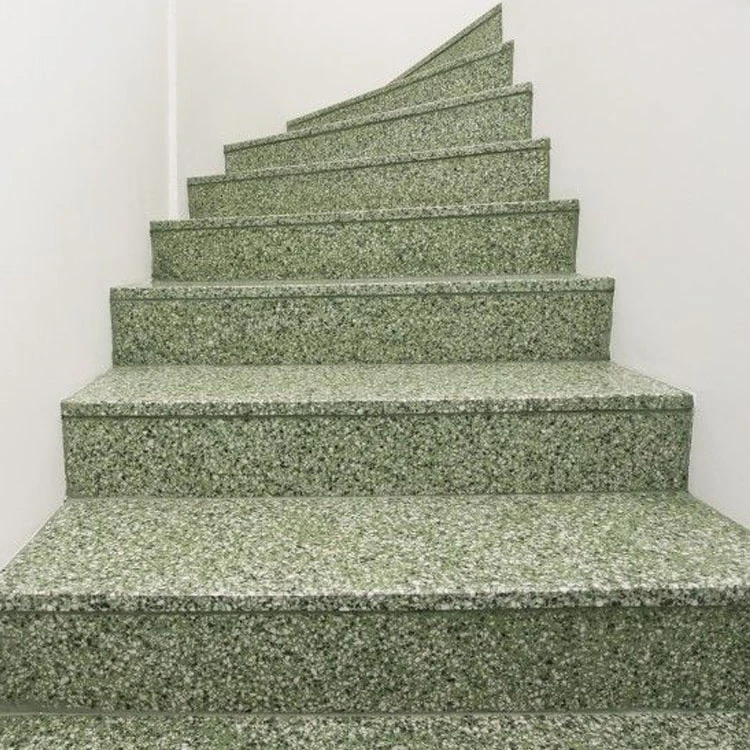
Terrazzo slabs belong to the category of large-sized prefabricated terrazzo slabs, with larger individual sizes. Common specifications include 1200 × 2400mm, 1600 × 3200mm, etc. The thickness can be selected from the range of 18-40mm according to the usage scenario. They can be used for floor paving, wall hanging, stair treads, countertops, and other positions. Large sized terrazzo slabs can reduce on-site splicing gaps and enhance the overall visual effect of the space, making them a highly demanded category in foreign trade orders in recent years.
From the perspective of raw materials, cement-based terrazzo slabs are more suitable for outdoor courtyards and walkways, and have the characteristics of UV resistance and temperature difference resistance; Resin based products have outstanding color saturation performance and are often used in indoor spaces. Terrazzo prefabricated panel manufacturers can provide panels with different formulas and surface processes according to the climate and usage environment of the project location. The surface can be processed into various effects such as high gloss, soft gloss, matte, sandblasting, etc., to meet diverse design needs.
2, Core product advantages of terrazzo slabs
Compared to natural stone and ordinary ceramic tiles, terrazzo prefabricated panels have various differentiated characteristics, which is also the reason why many overseas projects prioritize this material.
Firstly, the quality stability is good. The entire production process is standardized in the factory, and the aggregate ratio, color, and density can be uniformly controlled. The color difference of the same batch of boards is controlled within a reasonable range to avoid quality fluctuations caused by weather and manual technology during on-site pouring. The board has been polished and inspected before leaving the factory, with stable dimensional accuracy. When supplied in large quantities, it can ensure the overall finishing effect of the project is uniform.
Secondly, there is ample space for customized design. The particle size, color type, and particle proportion of the aggregate, as well as the base color of the board, can be adjusted. Special aggregates can also be embedded to create exclusive textures, suitable for various design styles such as retro, minimalist, and industrial style. The large size of terrazzo slabs can reduce seams and is suitable for achieving a coherent and unified visual effect in large public spaces.
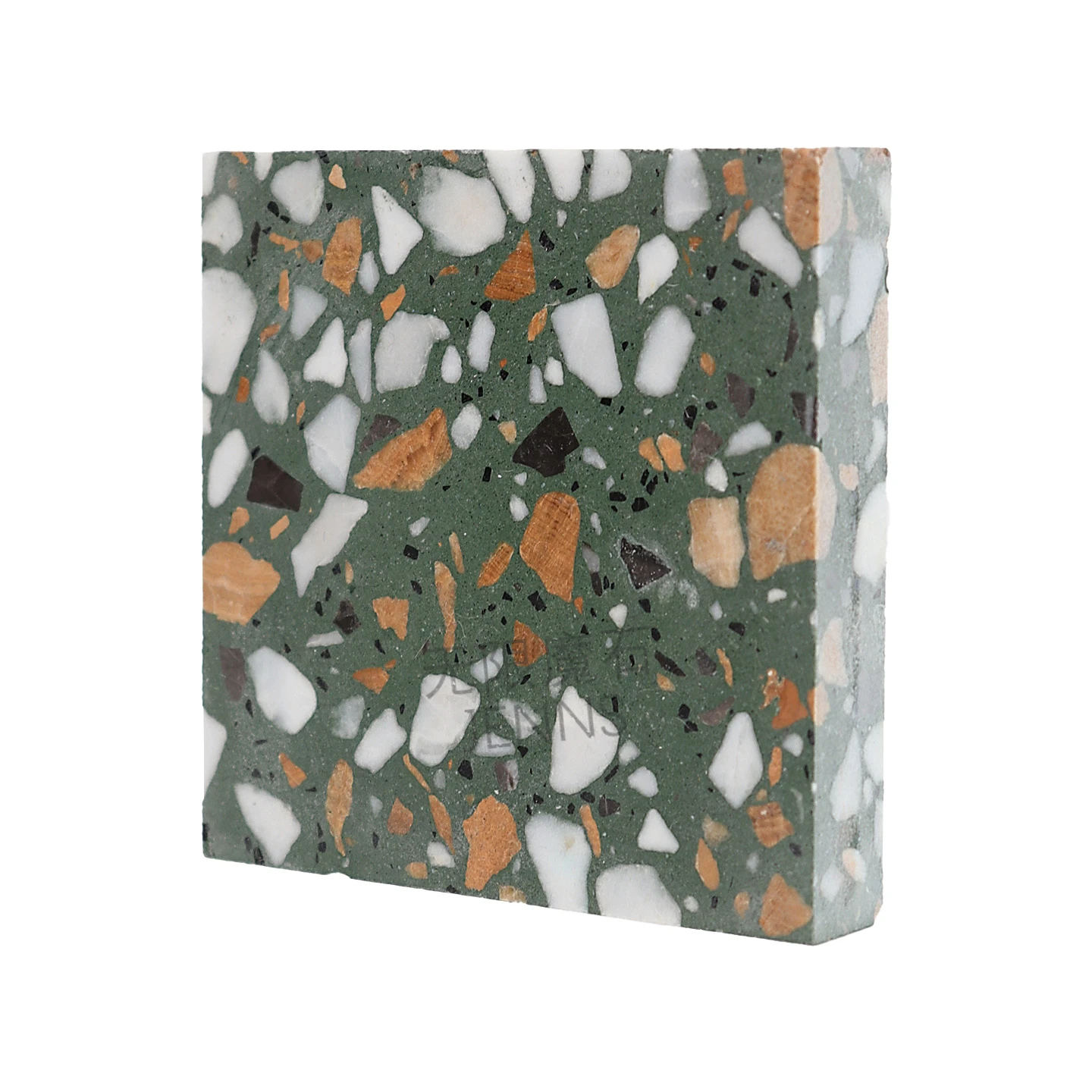
The third is the adaptation of physical performance to multiple scenarios. High quality prefabricated terrazzo with a Mohs hardness of 6-7 levels has good wear and impact resistance, suitable for areas with high pedestrian traffic such as shopping malls and exhibition halls; Cement based products meet the fire resistance standards and have good anti slip performance. They can maintain appropriate friction even in humid environments and can be used in areas such as bathrooms and outdoor walkways. The board that has undergone anti-seepage treatment has a dense surface structure, reducing the risk of stain penetration. Daily maintenance only requires wiping with a neutral cleaning agent.
The fourth is that the construction period is controllable. After the board arrives at the project site, it is directly laid or hung, eliminating the need for pouring, on-site maintenance, on-site polishing and other processes, shortening the on-site construction time, reducing on-site labor input, and being more friendly to overseas cross-border projects with tight schedules.
In terms of environmental protection, some products will use recycled stone processing waste as aggregates to achieve resource reuse. Inorganic cement-based products do not contain volatile organic harmful substances and are suitable for low-carbon building requirements.
3, Simple horizontal comparison with natural stone and ceramic tiles
Natural stone has a unique texture, but there are color differences between different mineral layers. When purchasing in large quantities, it is necessary to screen and arrange the materials, and the material cost fluctuates greatly. Some marble has low hardness and is easily eroded by acidic substances. Ordinary ceramic tiles have a wide range of color options, but the texture of the particles is insufficient, resulting in a large number of joints when laid in large spaces.
Terrazzo prefabricated panels are between the two, with a hardness better than marble and similar to granite; Color and texture can be customized according to demand, with stronger consistency in bulk supply and a moderate overall cost. Of course, it also has its own limitations. The cement-based terrazzo slab has a large self weight, and logistics and structural loads need to be considered in advance in the project. When purchasing, the thickness and self weight parameters can be communicated with the terrazzo prefabricated slab manufacturer for reference in structural design.
4, Common problems and solutions for the installation of terrazzo slabs
Even if the quality of the board itself is qualified, if the on-site installation process is not in place, problems such as uneven gaps, hollowing, and later cracking may still occur. Overseas projects need to avoid these issues in advance. Below are several high-frequency problems and countermeasures.
1. Inconsistent gap width: mostly due to insufficient flatness of the base layer or lack of advance planning for on-site layout. Before construction, it is necessary to level the base layer. After entering the site, pre layout should be carried out to confirm the layout plan of the board before formal laying. Uniform expansion joints should be reserved to cope with the deformation of the board caused by temperature changes.
2. Board hollowing: Uneven application of adhesive and incomplete cleaning of floating ash on the base layer can easily cause hollowing. Before construction, clean up the dust and debris on the base surface, select suitable bonding materials according to the specifications of the board, ensure uniform coating thickness, and prioritize the use of laying technology suitable for heavy-duty boards for large-sized terrazzo boards.
3. Cracks appear in the later stage: Some of the cracks are not caused by the fracture of the board itself, but by the transmission of stress from the building base structure to the board. In response to such situations, it is recommended to add crack resistant isolation layers at the grassroots level to reduce the impact of building deformation on terrazzo slabs.
4. Surface contamination and discoloration: It is not recommended to use strong acidic cleaning agents for a long time on cement base surfaces, as they will erode the surface gloss; For outdoor use, cement-based formulas are preferred to avoid discoloration of resin based products due to long-term sun exposure. After installation, regular sealing and protection treatment can be carried out according to the flow of people to extend the service life of the decorative surface.
5, Procurement selection tips
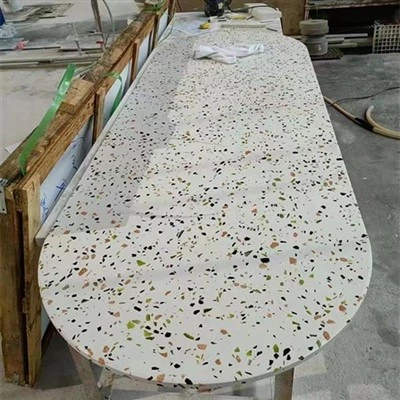
When purchasing terrazzo slabs for overseas projects, it is recommended to confirm in advance whether the project is for indoor or outdoor use, the temperature and humidity environment, and clarify the thickness, size, aggregate scheme, and surface technology of the slabs with the terrazzo prefabricated slab manufacturer. At the same time, the packaging scheme should be confirmed. Since the slabs are heavy, wooden frames are generally used to reinforce the packaging for export, reducing the risk of collision and damage during ocean transportation. Samples can be requested to verify the color and particle effect of the actual product, confirm the parameters before mass production, and reduce project deviations in the later stage.
Overall, terrazzo prefabricated panels and large-sized terrazzo slabs combine decorative, durability, and prefabricated construction advantages, and their application scenarios continue to expand in global commercial, public building, and landscape projects. Proper selection and on-site installation control can better leverage the value of the materials themselves.